How to Photograph Local Markets Respectfully: A Beginner's Guide to Consent, Light, and Composition
At half past six the market is still a workshop. Crates come off tailgates, ice goes down, and someone is stacking tomatoes into a pyramid that will not survive the first customer. Twenty minutes later the light turns gold, the aisle fills, and the whole scene becomes a photograph. That is exactly why markets attract cameras — and why they are one of the easiest places to behave badly with one. A market is somebody's workplace, not a stage set. The good news is that taking honest, beautiful pictures there is not complicated. It comes down to three habits: asking well, watching the light, and composing with patience.
Consent Is a Conversation, Not a Formality
The difference between a good market portrait and a snapshot of a stranger is usually four seconds of contact. Catch the vendor's eye, lift the camera slightly, raise your eyebrows. Most people understand the question before you say anything.
If you want to be certain, ask. Keep it short and specific rather than grand. "May I take a photo of you working?" lands better than "Can I photograph you?" — one is about the moment, the other can feel like it is about the person. Point at what you mean: the scales, the hands, the arrangement of fruit. Naming the subject tells them exactly what they are agreeing to appear in.
What to say, and what comes after
Learn the local phrase for "may I take a photograph" and use it badly. The attempt is appreciated, and it is far better than fast English delivered at volume. If the answer is a nod, shoot two or three frames and then show them the back of the screen. People are curious about how they look, and the exchange turns a transaction into a moment.
Carry a card, or be ready to type an email address into your phone. "I would like to send you this" costs nothing and changes the tone of everything. Some of the best conversations I have had in a market started with a picture and ended with a recommendation for a bakery two streets away.
Goods, faces and hands
A pile of lemons is not a person and does not need permission. A vendor's face, hands and posture do. There is a middle ground — wide shots where individuals are small and unidentifiable — that rarely causes offence, and a narrow one where a single person fills the frame and always should be discussed first. If someone says no, say thank you and move on without a flicker of disappointment. It costs you one photograph. It costs them their morning if you push.
Reading the Light Before You Read the Scene
Markets are lit in layers, and the light changes by the metre. Walk the aisle once without raising the camera and notice where the brightness falls.
Before the sun clears the roofs
Early light is soft, cool and forgiving. It is the easiest hour for faces, but it is also dim. Do not be afraid to push sensitivity up and shutter speed down; a little grain is a fair trade for an unblurred hand reaching for a paper bag. Brace against a pillar, tuck your elbows in, and breathe out before you press.
Once the sun is high
Hard light is not the enemy. It gives you backlighting, and backlighting gives you the things markets do best: steam off a griddle, dust in the air, the bright halo around a hat as someone leans over a crate. Meter for the highlights so the bright edges stay clean, and let the shaded side of the subject fall dark. Faces become silhouettes, hands stay readable, and the picture starts to look like the place felt.
Under the awnings
Canvas casts colour. A red tarp will tint every face beneath it; green netting will do the same in the opposite direction. Look at something you know is white — a paper bag, a shirt, a crate label — and you will see the cast immediately. Either move so the subject is lit by neutral or bounced light, or accept the cast and correct it later. White trays, polystyrene boxes and pale walls all throw useful light back up into a face.
One firm rule: no flash without asking. It startles people, flattens the scene, and announces you in a place where you would rather be quiet.
Composing in the Middle of Chaos
A market refuses to be tidy. Everything is happening at once, at three depths, and your instinct will be to point at the busiest part. Resist that. Decide first who or what the photograph is about, then arrange the rest around it.
Think in layers. A crate edge in the foreground, hands weighing produce in the middle, a row of stalls receding behind: that is a photograph with depth rather than a flat wall of merchandise. Get low — waist height or lower — and the aisle becomes a corridor of leading lines instead of a crowd of legs.
Then wait. The gesture is what makes the frame: the wipe of hands on an apron, the lift of a scale, the shrug of a vendor explaining a price. Find your background, get your exposure right, and hold the camera there until someone walks into the picture. Two minutes of standing still will give you a better photograph than twenty minutes of wandering.
- Frame through things: doorways, hanging scales, gaps between stalls.
- Keep a strong vertical somewhere — a column, a pole, a stacked tower of crates.
- Shoot verticals for individual vendors and stall detail; horizontals for interaction and aisle.
- Leave a little space in front of a walking figure so the frame has somewhere to go.
- Do not centre everything. Off-centre subjects let the market breathe around them.
When the Answer Is No, or Nothing at All
Not everyone will tell you plainly. Watch for the quieter refusals: a hand raised, a face turned away, a body angled behind the stall. Someone stepping into the back of their shop as you lift the camera has answered you. Put the lens down, nod, and move on.
Some people simply do not want to be photographed, for reasons that are none of your business. A child's face, in particular, is worth approaching with real caution — ask the accompanying adult, and accept a refusal without negotiating. If you plan to publish or sell the images, remember that rules about photographing people in public vary and that commercial use is treated differently from personal work. Check what applies where you are, and when in doubt, ask.
Editing and Sharing With Care
Whatever you promised, keep it. If you said you would send a picture, send it that week. When you edit, aim for the place as it was: warm light, real skin tones, a little mess. Heavy contrast and pushed saturation make markets look like stock photography and lose the thing that made you stop walking in the first place.
Caption with respect. If a vendor gave you their name, use it. If they told you the story behind the stall, you have been handed something better than a photograph — do not waste it.
A Short Field Checklist
- Walk the market once with the camera down. Note the light and the quieter corners.
- Ask before faces and hands; photograph goods freely.
- Buy something from the stall you most want to photograph. It is the simplest form of thanks and usually the start of a conversation.
- Keep out of the aisle when you stop to shoot. Stand at the edge, not in the flow.
- Show your best frame at the end. Leave a contact detail if they want a copy.
- Take fewer pictures, more slowly, and leave when the light does.
Do those things and the market will keep letting you in. The photographs get better too — quieter, closer, more like the place and less like a performance. Come back the next morning and someone may wave you over to the corner where the light is best.
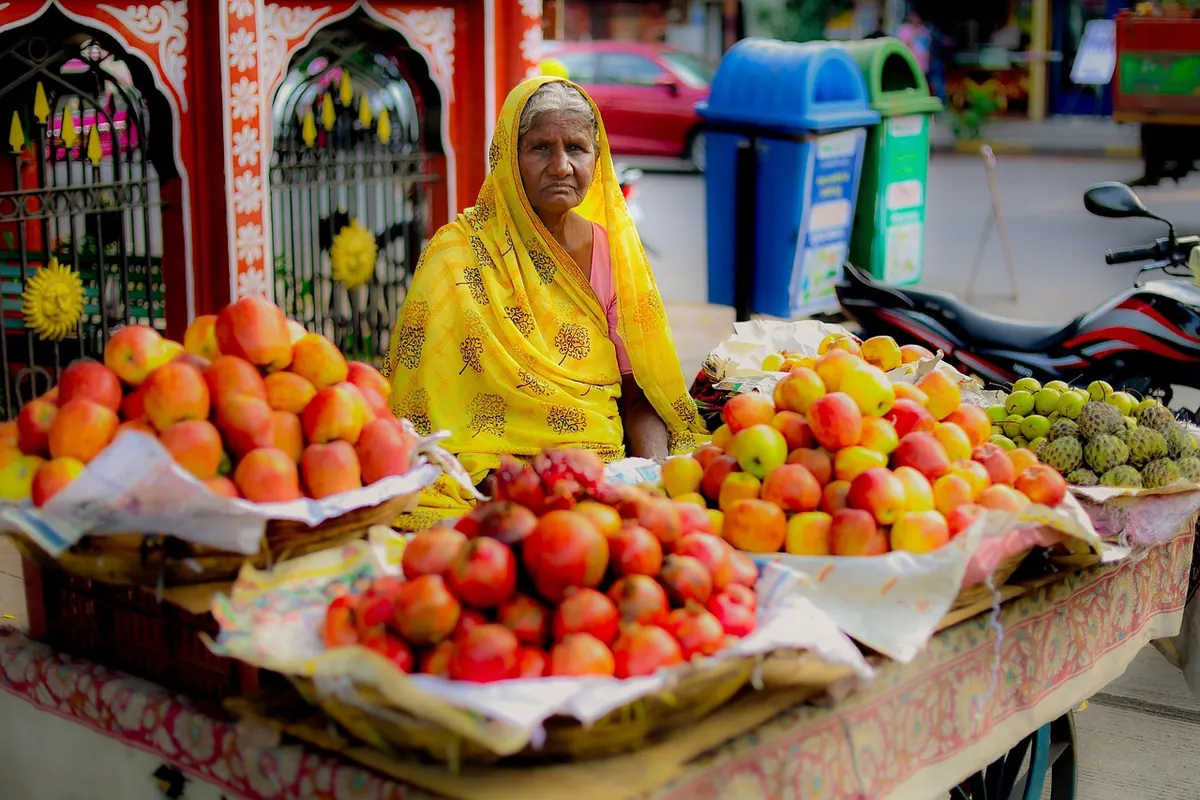
Photo: anngadpandey / Pixabay